
Introduction
In recent decades, the concept of the Limb Symmetry Index (LSI) has emerged as a cornerstone in the assessment of athletes undergoing anterior cruciate ligament (ACL) reconstruction. Originally introduced as a simple and standardized indicator to measure functional recovery, the LSI quickly gained popularity, becoming one of the main criteria for determining an athlete’s readiness to return to sport. The initial idea was straightforward: compare the performance of the operated limb with the healthy one through functional tests, such as single-leg hops, and establish an acceptable threshold of asymmetry—often set below 10%.
This approach gained widespread acceptance, especially due to its apparent objectivity and ease of use. Clinicians could rely on a number to make complex decisions. However, this very simplicity was both its strength and its downfall. Over time, the LSI transformed from a useful tool into a sort of “Holy Grail” of rehabilitation, with excessive emphasis placed on symmetry as the ultimate goal rather than as a partial indicator of recovery.
As research has advanced, doubts have emerged about the universal validity of the LSI. Why a 10% threshold? And who can guarantee that the athlete was symmetrical before the injury? These questions have led many experts to reevaluate the meaning and weight of this index. Today, we know that while LSI is useful, it is far from being a definitive measure for evaluating rehabilitation success and the risk of reinjury.
A Dependence on Numbers
For years, the 10% limit was considered the milestone to achieve for a safe return to sport. However, this emphasis on symmetry has led to an oversimplified view of the complex rehabilitation process. The search for a single number capable of answering all questions regarding the athlete’s safety and readiness has created an illusionary narrative. It has overlooked the fact that an athlete is not an equation but a complex combination of physical, psychological, and contextual factors.
Paradoxically, later studies have shown that many athletes with an LSI below 90% never reinjured themselves, while others with excellent symmetry suffered relapses. This raises fundamental questions: how truly predictive is this parameter? And what if symmetry itself were a misleading goal?
Another critical aspect is that focusing on LSI can lead the athlete to “cheat” unknowingly: underperforming with the healthy limb to approach symmetry or, conversely, overloading the operated one to compensate. In both cases, the result is a distortion of reality, undermining the validity of the test and the clinician’s confidence in their decisions.
The Limitations of the Traditional Approach
Too often, in the attempt to achieve symmetry, we forget that the rehabilitation process is not linear. Training only the operated limb while neglecting the healthy one can amplify initial imbalances and create new dysfunctions. Moreover, the obsession with symmetry has sometimes reduced the athlete’s role to that of a mere test performer, ignoring their active involvement in the decision-making process.
The risk is losing sight of the real goal: restoring not only functionality but also confidence and the skills needed to compete at a high level. For some athletes, a certain degree of asymmetry might even be normal or functional, especially if accompanied by high overall performance.
The Complexity of Returning to Sport
The decision to clear an athlete for return to play should be based on a holistic evaluation, including not only physical parameters but also psychological and contextual factors. The recovery of sport-specific skills, stress management, and the prevention of dysfunctional compensatory strategies should be central to the process. The pursuit of perfect symmetry cannot be the only objective, and LSI should not be considered the ultimate judge.
Symmetry: An Overrated Risk Factor?
In the debate on injury prevention, symmetry is often presented as a crucial goal to pursue. Coaches frequently speak of symmetry as the key to reducing injury risk. However, this concept also risks falling into the trap of oversimplification. How many athletes, despite being clearly asymmetrical, never suffer injuries? I am not denying that the degree of asymmetry can be a potential risk factor, but for it to become problematic, additional conditions must occur that, when combined, create a truly risky situation.
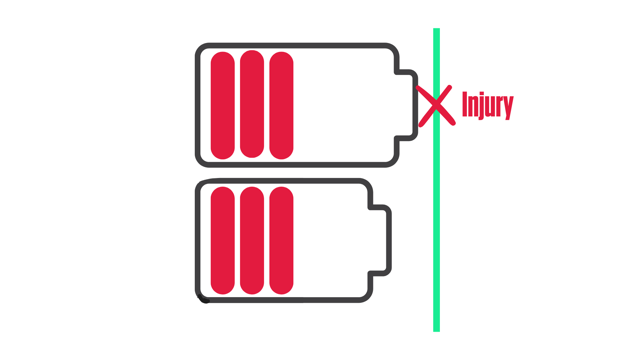
Take, for example, a high-level basketball player. If, due to tactical reasons or rotation, he play a limited number of minutes, his level of asymmetry might have little impact on injury risk. Conversely, the risk could be much more influenced by their overall performance: if the athlete feels the need to excel to gain more playing time, he might push his body to the limit or even beyond its physical capacities, increasing the risk of injuries—but not due to asymmetry, rather due to exceeding anatomical limits (Case A). The same athlete, if he has no interest in standing out and plays without much effort, will not experience excessive fatigue, and the risk of injury will remain relatively low, with little relation to their level of asymmetry (Case B). However, if this athlete begins increasing his playing time and fatigue starts reaching their personal limit, then asymmetry might indeed contribute more significantly to the risk of injury (Case C).
A)
B)

C)
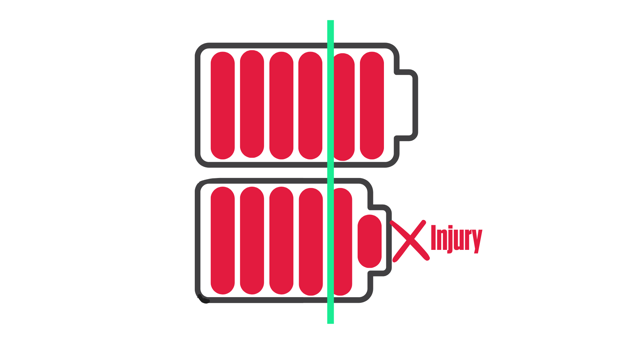
IMAGE CAPTION: The two batteries represent the two limbs, the battery length represents the capacity of each limb, the markings indicate limb fatigue, and the vertical green line represents the load the athlete has endured
Considering everything stated above, I wonder: does it make sense to try to reduce asymmetry as a tool for injury risk reduction? My answer is that in specific cases, it might make sense, but in general, if the goal is to lower the probability of injury or reinjury, the primary focus should be on increasing physical capacity. Chasing symmetry might distract from the primary goal of training, which is performance improvement.
I believe the same concepts apply to post-ACL reconstruction rehabilitation. Even with the aim of reducing reinjury risk, my goal is to make the athlete adequately performant in their specific context with both limbs. I see symmetry as informative but not decisive, unless there is a generally low level of physical capacity.
Ultimately, symmetry is just one of many variables and not necessarily the most determining one. Focusing solely on it risks diverting attention from other, perhaps more relevant, aspects of injury prevention and athletic preparation.